The Touhou series made its first release in 1996, and has since seen fourteen main series games, with another seven on the side. With so many titles, Touhou is obviously a very well established series with an extensive catalog of core characters, with many more supporting as well. Interestingly enough, I should add, is that almost every character that's encountered is female. Not a bad thing if you ask me!
Anyways, the particular game I happen to be reviewing is the eleventh main series game: Subterranean Animism. Released in 2008, it is without a doubt the most challenging game in the entire series. In fact, many would claim that it may be one of the most challenging games in the entire genre! This would be saying a lot, considering that curtain-fire shooters are among the most challenging styles of games out there.
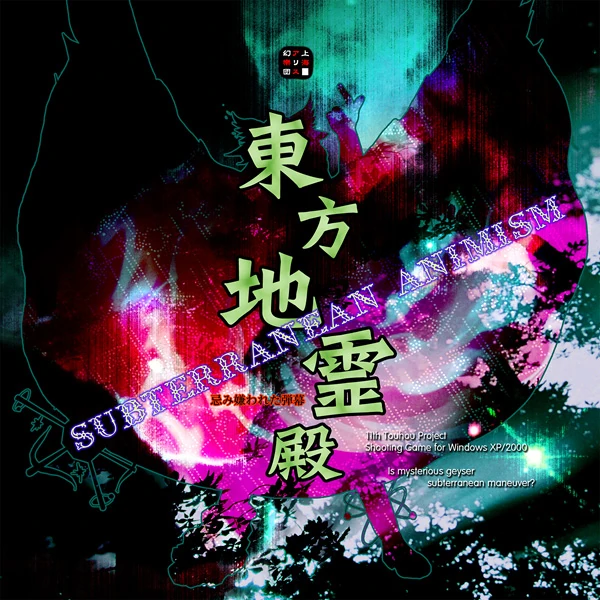 |
| Cover art |
Like most games, it would be overbearingly tedious and impractical to go into detail on every single song in the entire game, but due to the structure of the gameplay, I will be able to go through the vast majority of them. With the simple pattern of stage-boss-stage-boss-etc..., I will go through each stage and each boss theme in detail. Other minor additions to the overall soundtrack will be overlooked. Clicking the titles will redirect you to each song, so I encourage you to check them out as you read.
Stage 1 Theme: The Dark Blowhole
I must say right off the bat, this is an excellent way to start out this game. The song is not to heavy or intense, so it fits well as a Stage 1 theme. But, at the same time, it is still very atmospheric and immersive. You are just now delving into the underground; you are not very deep just yet, but you are still beneath the surface of the Earth.
For most of the song, the drums give it a very driven feeling. It's early on in the heroine's adventure, and a lot of the initial energy and stamina remains. But, at the same time, the bass reminds you that you are indeed still in a cave. It gives enough of a dark feeling as to still induce a mild sense of claustrophobia. As the song progresses, slightly more bright sounding tones get thrown in, as well as some higher pitches. This helps to even better balance the feeling of initial energy and excitement with the dissonance of being underground.
 |
| Yamame Kurodani |
Not too far into her journey, the heroine encounters her first major enemy: Yamame Kurodani. She is an Earth Spider, despite not really appearing to be such a creature. She is a youkai who has the ability to manipulate illnesses, particularly infectious disease. Because of this, she was sealed away in the underground. As the heroine ventures deep enough into her cave, she attacks. Thus, initiating the first boss battle.
It is a bit more fast paced than the stage theme, but loses most of its dark atmosphere. It's all about energetic battling. Personally, I don't think this is the best theme that could be used in such a situation. It is a decent
stand-alone song for a first boss, but considering the particular game that it appears in, it is a little too fast and bright to be perfectly suitable.
Stage 2 Theme: The Bridge People No Longer Cross
Deeper, deeper you delve into the depths of the underground. The music slows, and loses any semblance of brightness and optimism that may have been conveyed in the previous music. You are now deep enough that there is no turning back, and you must face whatever twisted creatures you find head-on.
Seriously, this is one of my favorite stage themes in the entire series. It is so dark and soulful, and few compositions can even match its atmosphere. The slow tempo really conveys the feeling of being sufficiently deep in a dark, dank cave far beneath the surface of the Earth. In fact, the feel of the song gets even slower and darker as it goes on, eventually summounting into very slow, deep, and drawn out notes. At this point, the song becomes so somber that it's almost as if all hope of returning to the surface has been lost. This coincides nicely with the fact that enemies are becoming progressively stronger as you journey farther and farther from the surface world.
 |
| Parsee Mizuhashi |
Finally, you reach the bridge that leads into the deeper parts of the Underworld. As you attempt to cross, however, you are attacked by the keeper of said bridge: Parsee Mizuhashi. Due to being so incredibly despised, she has grown to harbor an extreme jealousy of everyone else, regardless of their situation. After having these feelings for so long, she has actually gained the power to manipulate jealousy in others.
Her theme continues on somewhat of a somber note, although it's three-count timing gives a bit more of a driven feeling than the stage theme. Also in opposition to the stage theme, it gradually feels faster and more energetic with time. I suppose such a feeling is a bit more suitable for a boss battle.
The song does however still retain enough of a dark and sad atmosphere as to still convey the feeling of being underground, and battling a girl with a very broken morale. So all in all, the theme is still quite fitting despite its slightly energetic pace.
Stage 3 Theme: Walking the Streets of a Former Hell
After crossing Parsee's bridge into Former Hell, the heroine arrives in what is now simply known as the 'Former Capital'. It is an underground village populated primarily by Oni who went there in order to contain the evil spirits of the Underworld. In contrast to the past two stages, it is not just a dark, gloomy cave, but is actually a center of civilization.
As such, the theme is quite a bit faster than the previous stage theme. Also, it's quite a bit more energetic, conveying the feeling that there's more to this area than just rocks and malicious creatures. In fact, it is energetic enough to demonstrate the party-loving spirits of the Oni who live in the village.
In spite of breaking the deep, dark, and claustrophobic nature of the game leading up to this point, the extra dynamics this song adds is actually quite refreshing. It also works well with the faster-paced nature of this particular stage. If it were as slow as the Stage 2 theme, it just wouldn't fit at all.
 |
| Yuugi Hoshiguma |
Third Boss Theme: A Flower-Studded Sake Dish on Mt. Ooe
Somewhere in the village, the heroine encounters Yuugi Hoshiguma, an Oni with a love of all things strong and brave, and no mercy for the weak and cowardly. Impressed by the heroine's strength, she decides to help them if they can beat her in a fight.
This theme is very lighthearted compared to the rest of the music in the game. It's very upbeat and almost happy, and contrasts greatly with some of the other themes. Although, it does indeed fit with the situation; you're battling someone who doesn't seem to have any sort of actual malicious will towards you, but is still immensely powerful and challenging.
Overall, however, this theme is hardly notable. There's nothing bad about it, but it just doesn't seem to grab me very well.
Stage 4 Theme: Heartfelt Fancy
After defeating Yuugi, she willingly directs you to the Palace of Earth Spirits. It is a mansion in the center of what was formerly Hell. As the song title implies, the mansion is quite fancy indeed. The song itself is also sufficiently regal and serves as a very appropriate accompaniment.
The theme is neither too fast or too slow; it carries along at a fairly moderate tempo. It is not all that bleak, but it does have a very solemn air to it. You'd better believe this song means business, but in the most high-class way possible.
 |
| Satori Komeiji |
The fancy aura of the stage theme is certainly carried over to the boss theme, as well. It's very regal and ornate, but at the same time, it gains quite a bit of energy compared to the stage theme. High energy themes are of course always preferred for fighting a boss characters, so this is a good quality without a doubt.
As the song carries on, it gets a little more abrasive. It starts to kind of dig in to you, but at the same time is still able to maintain some of its original feel. The character whom it represents is a legendary youkai named Satori Komeiji who has the terrifying ability to read the minds and memories of her opponents, so the fear that this should incite is embodied quite nicely in the later measures of the composition.
Stage 5 Theme: Lullaby of a Deserted Hell
After being defeated, Satori will direct the heroine into the Palace's courtyard in order to find the root of the incident. In the courtyard is a hole that leads directly into the Remains of Blazing Hell; a segment of Former Hell that was once used to contain banished criminals.
All that surrounds you is blazing fires and the projectiles of enemies... The rest is utter desolation. The only sounds to be heard at first are the subterranean winds, as the heroine is greeted with her first wave of enemies. After weaving through the extremely dense field of initial projectiles, a very slow, sad, and lonely sounding song begins to play. It is choreographed EXCELLENTLY with what is going on in the actual game at this point. The initial windy sound effects amplify the tension of the first waves so much, it is almost overwhelming. It is definitely one of the most intense points in the entire game...
But then, when the actual music begins to play, there is a massive release from the tension. It is an interesting feeling. The early stages of the song are very soft and lighthearted; it is a little bit contrasting to the atmosphere of the actual stage. But at the same time, it's slow tempo matches the pacing of the level very well. It is slow, drawn out, and very dense, just like everything else that is going on.
As you get deeper in, however, the mood of the song begins to grow even more and more tense. By the middle sections, it gets so incredibly dark and solemn that I can hardly even express how it feels. At this point in the level, you are having to weave through very wide and complicated zig-zags, and despite the slowness of the song, it couldn't fit more perfectly. Plus, despite the slow tempo, there is some faster bass parts being played in the background. Something about it just gives off the most perfect feeling of descent... You are in some of the deepest depths of Hell, and are continuing to go even deeper into the blazing fires. It's so intense that there's this sort of solemn beauty to it. It's probably the most amazing and awe-inspiring feeling I've ever felt in ANY video game.
As the song progresses from that point, it begins to slowly wind down. Eventually, it reaches a very organic end as it dies down into the sounds of the wind once more. At the time you can hear the wind again, no more enemies approach you, except for one...
 |
| Rin 'Orin' Kaenbyou |
Out from the blazing fires of Hell, a familiar and seemingly minor character reveals her true form: Rin Kaenbyou, a kasha in charge of carrying corpses in her wheelbarrow that are to be used for the heating of Hell.
The song begins immediately with a dissonant slide the moment that she phases into her more humanoid form. The perfect aural accompaniment to her sudden and unexpected transformation. The rest of the song afterwards, however, is not very tense, much unlike the stage theme. But at the same time, there is a certain epicness to it. It's not overbearing, though; you've come very far along this journey, overcame many challenges, but it is not over quite yet. The final trial still lays ahead, but it is still close enough that its gravity is still palpable at this point. A very good second-to-last Boss theme.
Final Stage Theme: Hellfire Mantle
Oh God. Oh DEAR GOD. If you have not felt any sort of fear, tension, or anxiety leading up to this point in the game, I'm certain that you will feel something of that sort right about now. These are the final moments leading up to the most intense battle that you will probably ever have in any video game you ever play.
The driving, epic procession drives you through the deepest depths of Former Hell as you approach the final boss. Not much more is to be said, but, this is the most perfect theme for a final stage that I have ever heard. Hot damn.
Final Boss Theme: Solar Sect of Mystic Wisdom ~ Nuclear Fusion
 |
| Utsuho Reuji |
This is the moment that the entire game has been leading up to. The ultimate trial of skill at the hands of Utsuho Reuji, a hell raven with the power to control nuclear fusion.
If you forgot that you were challenging the final boss of an extremely difficult shooting game, the first few notes will remind you right away. The initial hard-hitting and deep sounds instantly instill the feeling of dread associated with challenging any opponent of immense power. Eventually, the song picks up with a bit more brightness, although still retains much of its tense and epic sound.
There a lot of breaks throughout the song that really amplifies the intensity of what's being played, and what's going on in the game. It's very dynamic, and fits very naturally with the feel of battle. But, even just the gravity of each individual part is enough to portray the absolute severity of this fight.
This is an excellent song to close the journey with. It is a pinnacle of the ultimate, tense madness that should be required of every final boss theme ever composed, and is elevated even farther in status by the fact that it is the most important song on a legendarily challenging game. This really is the crown of the entire game. Beware its intensity.
...
On top of these six regular levels, Subterranean Animism (as well as most other games in the series) contains one extra stage that is unlocked upon clearing the rest of the game without using any continues (or 'extends', as they are referred to in this game).
Extra Stage Theme: Last Remote
This is probably the most fitting song in the game for representing the darkness and claustrophobia of being underground. Ironically, however, this is the one stage where you are not underground at all! Interestingly enough, you are at a shrine instead.
It starts out very atmospheric, instilling a sense of utter confinement in the listener. But at the same time, there are a lot of high-pitched, almost beep-like notes being played fast. This gives the song an almost alien feel. As the song continues, there is a lot of build-up, ultimately resulting in a somewhat melancholy melody. The mood of said melody is somewhat altered, however, because the pacing of the accompanying music is too fast to be remotely melancholy, giving the song a very intriguing at ambivalent air.
But, while this is an excellent song (one of the best in the series, in fact), it just does not fit with the actual stage. It is a bit disappointing in a sense, but at the same time, it's such a great song that it's easy to overlook this fact. Oh well. Everything can't be perfect, after all!
 |
| Koishi Komeiji |
In the shrine, you encounter none other that Satori's sister, Koishi. Like Satori, Koishi technically has the power to read the thoughts and memories of others, but, to avoid the loathing that Satori is subject to due to her ability, she has shut her third eye. This has caused her to essentially be blocked off from her own conscious mind, and thus, she has no detectable personality to those who encounter her.
Her theme is very... Enigmatic. It oscillates between many styles and voices without much of a coherent theme. Despite this, it is actually very well done, so all these strange features cause it to be intriguing rather than just annoying.
One thing to keep in mind about battling Koishi, is that defeating her takes a VERY long time. As Utsuho was the ultimate trial of skill, Koishi is the ultimate trial of stamina. That being said, the plethora of different passages in the song is even more of a high point, considering that you will be listening to it for quite a while. It does a very good job of staying interesting for an extended period of time compared to other looping videogame songs that would just get repetitive after the amount of time it takes to defeat her.
...
Overall, Subterranean Animism has one of the best videogame soundtracks I've ever heard. Although it has its weak points, its strong points more than compensate for them. The combination of the style of music and setting of the game produces one of the most atmospheric and immersive gaming experiences I've ever encountered.
Even if you aren't a huge fan of curtain-fire shooters, I would still highly recommend that you check out the Touhou series. Maybe it would be enough to get you hooked on the genre. Besides, there are other types of games in the series. There are currently four Street Fighter/Mortal Kombat/etc... style fighting games out, as well.
However, I advise that you not start with Subterranean Animism if you do decide to check Touhou out, unless you are very experienced with other games of this genre. If you are still a beginner to this type of game, I would recommend Mountain of Faith (number ten), or Imperishable Night (number eight) as a much better starting point. But, I suppose you could still try this first if you feel so compelled. If you're looking for a challenge, it's not a bad idea!
If you own the rights to any content that appears in this article, and would like it to be removed, contact me at xenogzus@gmail.com and voice your concern. I will happily comply with any reasonable demands regarding the removal of said content.

No comments:
Post a Comment